

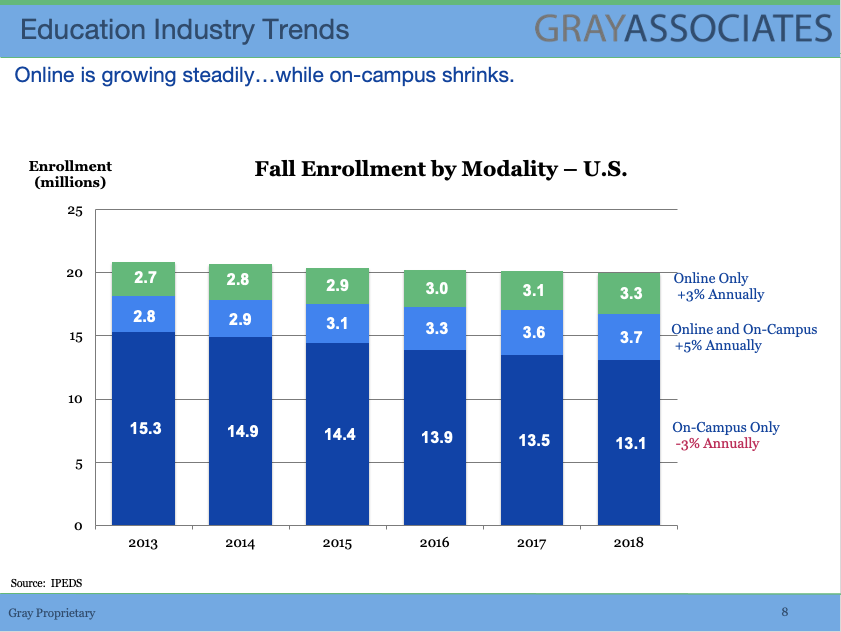
Years before the pandemic, online enrollment began its rise. Using the most recent data from IPEDS through 2018 for on-campus fall enrollment, we discover a downward curve of three percent, year-over-year, since 2013. In contrast, there is a three-percent growth in online enrollment.
Now, of course, we have a year of pandemic lessons learned behind us. We begin to recognize the value of online programs in higher education, even while we continue to adjust to its turbulence.
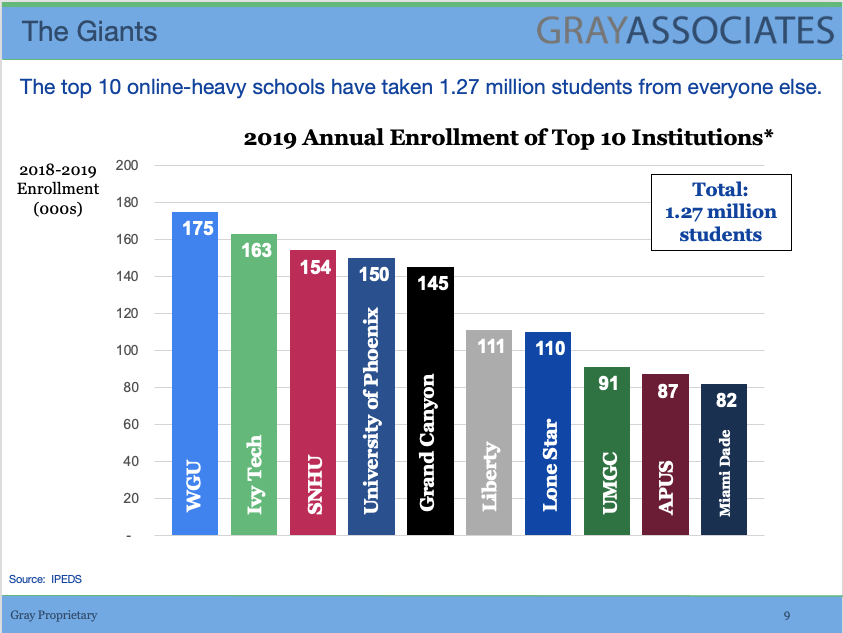
If you’re an on-campus institution, it’s not an easy market. Online institutions are gaining traction. If we look at 2018 to 2019 enrollment below, we discover another problem. Online-heavy institutions are successfully scaling up with student populations of nearly 100,000 students, and in some cases, more.
One online institution can claim a higher enrollment than that commanded by some state-based colleges and universities.
Who’s Who in Online Colleges and Universities
The big 10 in the online higher education space have claimed approximately 1.3 million students, students who might have enrolled in traditional on-campus institutions.
According to recent data, the largest online higher education provider is Western Governors University, with an enrollment of 175,000 students. Southern New Hampshire serves 154,000 online students, and the University of Phoenix 150,000.
The reality is that these schools will continue to add new students each year, in larger and larger quantities. To put it another way, an online giant can add enough additional student enrollment, that they are comparatively absorbing the equivalent of an entire college…each. These students are coming away from your market and major programs.
The big 10 are impressive. But there are a number of smaller online competitors that may also be taking a share of your potential students. Some may be fully online schools, while others may offer hybrid studies, with significantly competitive and attractive online programs that lure not just new enrollments, but existing students as well.
Identifying the Real and Relevant Online Program Competition
Not every online program or institution is a threat in your market. And it goes both ways; build a strong online program that meets student demand, and suddenly you are the one capturing the boom in online growth. But you need to know who exactly is in your market. You might think to take a look at IPEDS data, but the online story it tells is distorted.
Below is a look at the Washington DC market. IPEDs reports ten schools with online completions.
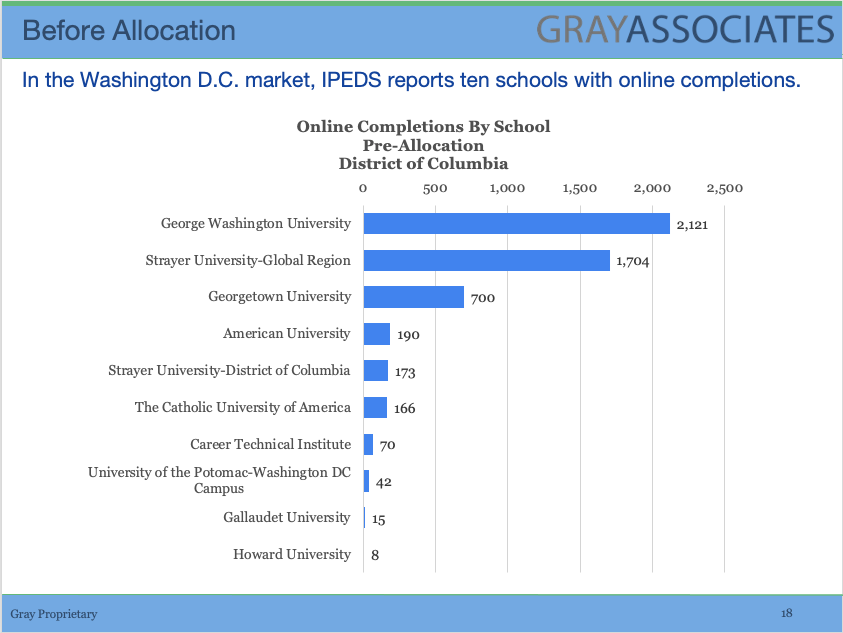
Most of these schools should be familiar to the market, and the online completions ranking seems to fall as expected. However, it doesn’t give an accurate picture of the competition coming into this market online. Remember, IPEDS reports online students as completing in the state of an online school’s address, not in the state where the student is completing an online degree. In other words, there could be many schools taking students out of the DC backyard, and that competition will not be reflected in the IPEDS data.
To gain an accurate understanding, we need to look at NC-SARA and its reporting by state. This allows us to see which online institutions are completing DC students.

There are 140 completions at the University of Maryland Global Campus, which is local to DC. But, there are others taking market share as well. The University of Phoenix turns out to be a heavy competitor in this market. With IPEDS-only data, they would have been completely hidden, reported only in Arizona. This shows how truly fragmented online competition can be for any given market.
Taking the Next Steps
By accurately identifying online competition, colleges and universities can better understand threats and opportunities in their markets, plan for growth, and create attractive programs to recapture student demand.