


The following article is an excerpt from Start, Stop, or Grow? A Data-Informed Approach to Academic Program Evaluation and Management.
In its basic form, curricular efficiency measures, manages, and improves the units of education that can be delivered for a given amount of instructional cost and quality. The metric we recommend, as a start, is cost per student credit hour (SCH). Subsequent posts will introduce metrics that balance cost and quality of instruction.
Calculating Instructional Cost
The math for calculating instructional cost per SCH is simple: instructional cost divided by SCH taught. This metric enables reasonably accurate comparisons across institutions, departments, programs, course levels, and courses. Let’s start at the bottom of this stack, with instructional cost per SCH.
Instructional cost is faculty wages and benefits, net of wages and benefits for non-teaching time, plus any consumables (e.g., lab supplies) used in the course. In this context, “cost” refers to what the institution pays to deliver a course, not what a student pays to take the course. Policy decisions heavily influence total instructional cost, the numerator of cost per student credit hour. These decisions also influence the denominator, setting guidelines for course credit hours and students per course.
Faculty Wage Levels
Wage levels are set in periodic policy decisions and are difficult to change in the short term. Wages for unionized faculty may be set for years under a collective bargaining agreement. While they are subject to great debate, changes in wages and benefits are often small from year to year; in theory, rising labor costs could be offset by improving efficiency.
Required Course Credit Hours
Policies also determine the number of course credit hours a faculty member should teach. The expectation varies widely, from zero for a prestigious researcher who wins substantial grants, to eight courses and twenty-four course credit hours per year for a typical community college professor.
Rounding Credit Hours
“Rounding:” Institutions may have policies on how to manage faculty loads when they do not divide evenly by standard course credit hours. A faculty member at one institution may be able to “round up” eleven course credit hours and declare that they have met their twelve-credit-hour target in a given semester. At another, they may be required to round down, and teach an entire additional three-credit course (for a total of fourteen course credit hours) to satisfy a twelve- credit-hour requirement.
Minimum Class Size
Minimum Students per Class: Many institutions have policies on the minimum number of students that must be in a class or section. Institutions may have the data and willpower to enforce these rules; or they may not have policies, timely reports to identify small courses before the add/drop date, or they may simply be unwilling to take on faculty and close small classes. Loose management of class size comes at a substantial cost.
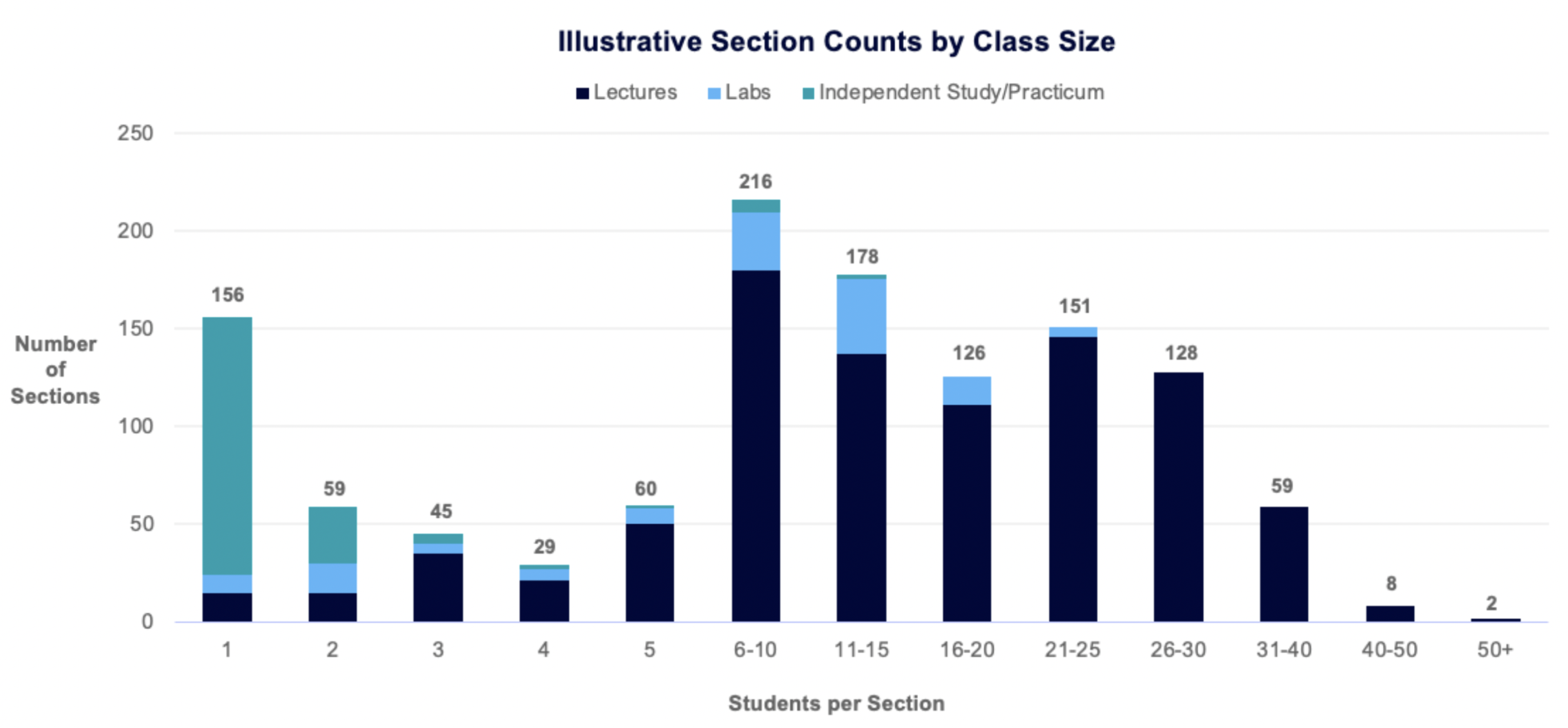
As illustrated here, hundreds of courses may run with under five students, driving up cost per SCH. I am frequently surprised at the number of courses with just one student. However, most are independent studies, and faculty often receive little or no pay for overseeing this work. Excluding courses with one student, in the example above, over one hundred tiny courses remain; the cost to deliver these courses often exceeds $1,000 per SCH.
This is the first of four blog posts in my Curricular Efficiency series. In future blogs, I will be covering the following topics:
- The actions you can take to better manage your courses
- Additional tactical decisions that can improve CE
- The impact that CE can have on a typical campus.
Start, Stop, or Grow? A Data-Informed Approach to Academic Program Evaluation and Management can be purchased through Amazon.