

Welcome to this blog post about the “Unplugged” movement.
Statistically speaking, there is a very strong chance you have already stopped reading this to check your phone.
It’s okay, we can hardly blame you. We are living in the age of the “Attention Economy.” This is a polite corporate term, of course, the equivalent of a tastefully neutral “quiet luxury” weighted blanket. But that pretty blanket is hiding the messy, cluttered trail of what led you to the blanket in the first place: that massive pile of “TikTok famous” overpriced skin products your teenager begged you for, or those vegan dog toys in the corner of your room that your dog has ignored entirely, exhausted as he is by his new raw food diet. Mostly, that gorgeous blanket is weighing you down so much that you can only gawp listlessly at your phone for hours, a casualty of the global battle over who gets your eyeballs for the most minutes today.
The Goldfish Evolution: From Minutes to Milliseconds
Back in the old days, say, a little over twenty years ago, the average human could focus on a screen for a whopping 2.5 minutes.
Today? Research says we’re down to about 47 seconds.
We have devolved into anxiety-ridden goldfish, bobbing in our own fishbowls, goggling blearily at our smartphones. We check our phones 96 times a day, and science says that once you get interrupted by a notification (which is probably happening right now), it can take up to 25 minutes for your brain to fully refocus on what you were doing.
That math is….alarming. We are essentially spending our waking hours ping-ponging back and forth between the things we should be focusing on and the things that are Hansel and Gretel-ing us right into the Witch’s House of Scrolling. Why are we like this? Well, because the algorithms know what we like, and unfortunately, what we “like” is often stuff that makes us miserable, so we keep looking for something to “like” that will make us feel “better.”
2024–2026: A Brief History of Digital Doom
In 2024, Oxford’s word of the year was “Brain Rot“, defined as “a perceived loss of intelligence or critical thinking skills, especially…as attributed to the overconsumption of unchallenging or inane content or material.” Then in 2025, Oxford’s word of the year was “Rage Bait,” defined as “Online content deliberately designed to elicit anger or outrage by being frustrating, provocative, or offensive, typically posted in order to increase traffic to or engagement with a particular web page or social media account.” In just one year, we charged past passive scrolling through rot and right into active fury. The internet realized the fastest way to get those aforementioned 47 seconds of your attention was to show you something designed specifically to make your blood boil.
And now? The Surgeon General says we are caught in a loneliness epidemic, despite being hyper-connected to everyone we’ve ever met since kindergarten. We are simultaneously overwhelmed by human contact and completely isolated.
The Pendulum Swings: Breaking the Digital Fever
As discontent with an always-connected digital world is growing, the pendulum is starting to swing back to something new (or is it old?): real-life, in-person activities and connections. Welcome to the “Digital Detox” movement.
According to Reeghan Gilden, Marketing Manager at Gray DI, “Screen-heavy lifestyles are linked to isolation, while offline activities, like arts, sports, and shared experiences are associated with stronger social bonds and better mental health.”
People are clamoring for “offline experiences.” Have you tried visiting a National Park lately? You need a timed entry permit just to look at a tree. We are so starved for reality that we have created pedestrian traffic jams in the wilderness. Live sports and concerts are booming because you can’t just download the smell of overpriced stadium hot dogs or the thrill of knocking over a bunch of actual people as you reach for a fly ball. And do you know a single person who hasn’t talked about “maybe picking up pickleball” at some point?
Perhaps most importantly, a study found that just one week off social media dropped depression by almost 25%, anxiety by 16%, and insomnia by 15%. Incredible! Who could have possibly predicted that maybe not looking at the Instagram account for that mean girl you went to high school with, who’s super famous now, might make you feel just a teeny bit better?
In reality, this movement is not anti-technology; it’s pro-balance. It’s about focusing on being fully present for a little while each day, rather than relentlessly chasing trends. You don’t have to put your phone down all day, but you could put it in your pocket, go for a walk, and take one or two pictures, but only if there’s a really cute dog.
Syllabus for the Real World: Can You Major in Being Human?
Higher education has taken notice of our collective nervous breakdown. Some institutions are beginning to launch academic programs that reflect this desire to find a better balance between the digital and natural worlds. Essentially, you can now major in Going Outside.
Gilden noted: “The unplugged concept is not about creating one universal major that’s going to fit every institution. Instead, it represents a few niche, mission-aligned opportunities that align with specific campuses, regions, and areas of expertise.”
We’re seeing programs like “Adventure Education” (learning how to be in nature without dying), “Ecotherapy” (using nature to calm down), and “CyberPsychology” (figuring out exactly how messed up the internet made us, and then trying to fix it).
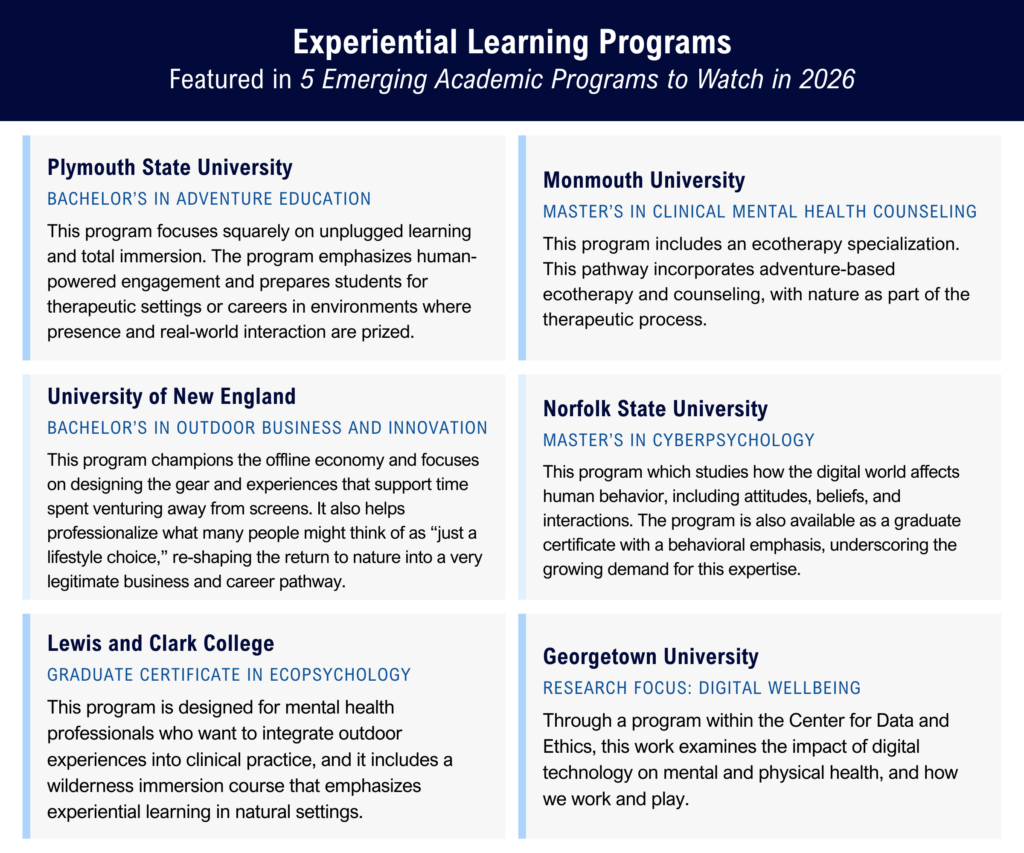
Here are some examples of recently launched programs that focus on experiential learning, with an outdoor focus. At Plymouth State University, the Bachelor’s in Adventure Education focuses squarely on unplugged learning and total immersion. The program emphasizes human-powered engagement and prepares students for therapeutic settings or careers in environments where presence and real-world interaction are prized.
The University of New England has rolled out its Bachelor’s in Outdoor Business and Innovation. This program champions the offline economy and focuses on designing the gear and experiences that support time spent venturing away from screens. It also helps professionalize what many people might think of as “just a lifestyle choice,” re-shaping the return to nature into a very legitimate business and career pathway.
Other programs focus on nature as a therapeutic tool. In 2023, Lewis and Clark College launched an Ecopsychology Graduate Certificate. The program is designed for mental health professionals who want to integrate outdoor experiences into clinical practice, and it includes a wilderness immersion course that emphasizes experiential learning in natural settings.
Over at Monmouth University, the Master’s in Clinical Mental Health Counseling includes an ecotherapy specialization. This pathway incorporates adventure-based ecotherapy and counseling, with nature as part of the therapeutic process.
Still other programs seek to help us find a balance between the digital and “real” worlds. Norfolk State University offers a Master’s in CyberPsychology, which studies how the digital world affects human behavior, including attitudes, beliefs, and interactions. The program is also available as a graduate certificate with a behavioral emphasis, underscoring the growing demand for this expertise.
Digital Wellbeing is also emerging as a research focus at Georgetown University through a program within the Center for Data and Ethics. This work examines the impact of digital technology on mental and physical health, and how we work and play.
Basically, these institutions are realizing the hottest new job skills might actually be “presence,” “resilience,” and “remembering how to make eye contact.”
We’ve arrived at the ultimate irony in 2026: we spent decades building technology to escape from reality, and now we are seeking reality (e.g., the outdoors, in-person experiences) to escape from all that technology.
And oh, hey, congratulations! If you made it to the end of this post without checking social media, you have beaten the 47-second average. You are elite.
Let’s go outside!
Curious to explore these programs in more detail? Click here to watch the full webinar, review the slides, and dig deeper into the data behind these emerging trends.