


When budget deficits hit higher education, the immediate reaction is almost always the same: find the low-enrollment majors and start cutting. It feels logical. It looks clean on a spreadsheet. But in academic portfolio strategy, the obvious cut is frequently the wrong one.
One of the most common and costly mistakes in academic portfolio review is assuming that low-enrollment programs are automatically weak programs. Sometimes they are. But more often than not, the picture is vastly more complicated.
When financial pressures mount, treating headcount as the sole measure of value can backfire dramatically. As higher education data expert and author Bob Atkins points out:
“Your program portfolio is the beating heart of your institution.”
Before taking a scalpel to that beating heart, institutions need to look beyond raw headcount and understand the hidden value, mission impact, and true economics of their academic programs.
Key Takeaways
- Headcount is deceiving: Small majors often support general education requirements that generate substantial credit-hour revenue across campus.
- Design over closure: Low enrollment often signals poor marketing, scheduling, or degree naming—not a lack of underlying market demand.
- Course-level economics matter: Slashing a small major rarely yields the cost savings leadership expects on paper without auditing shared course dependencies.
1. Why Small Majors Are Often Misunderstood
Evaluating a program strictly by the number of degrees conferred ignores how academic departments operate in practice. Small programs frequently serve crucial roles that keep the rest of the institution running:
- The Small Major That Teaches Everyone: A department may graduate only a handful of majors each year, but its faculty often teach required general education courses for hundreds of other students. English, history, math, philosophy, and communications supply fundamental writing, quantitative reasoning, civic learning, and critical thinking skills. Cutting the major rarely eliminates the need for those foundational courses. If the courses must still be taught, you may even lose money if the program is sunset.
- The Mission-Critical Niche: Some programs serve an indispensable institutional purpose. They may address regional labor needs, support public service, prepare local teachers, serve rural healthcare needs, or expand access for underrepresented populations. A purely market-based review undervalues these offerings. A sound portfolio process doesn’t ignore mission—it makes mission visible alongside student demand, labor market trends, and institutional economics.
As Bob Atkins succinctly puts it:
“It’s true that all programs that lose money are small, but not all small programs lose money.”
2. Low Demand or Poor Design?
A program may appear weak on paper because enrollment is low, but the underlying market demand might actually be strong. The problem often isn’t the subject matter—it’s execution.
Issues such as outdated degree titles, inconvenient modalities, rigid scheduling, confusing admissions pathways, or unclear career outcomes can suppress enrollment in a program that students would otherwise want to enroll in.
Case in Point: Consider an institution whose Philosophy major graduates only three students a year. On paper, it looks like an easy target for closure. However, that same department teaches mandatory critical-thinking and ethics courses to over 1,000 Nursing and Business majors annually. Eliminating the major saves zero dollars on faculty salaries—because those courses must still be taught—while needlessly destroying an attractive admissions hook for pre-law applicants.
In these cases, closure is the wrong tool. The right answer is redesign.
- A misaligned program can be repositioned.
- An invisible program can be marketed.
- A program lacking career clarity can be connected directly to job outcomes.
- A broad major can be rebuilt into a certificate, concentration, or interdisciplinary pathway.
3. Program Economics: The Safeguard Against Bad Cuts
Program-level headcount alone rarely tells leaders where money is actually being made or lost. Course-level economics serves as one of the most vital safeguards against self-destructive budget decisions.
A small major can still generate significant total credit hours if its faculty carry large service-teaching loads. Conversely, a large program that looks healthy on the surface might require tiny specialized lab sections, expensive equipment, or significant faculty release time, all of which drain resources.
Indiscriminately slashing small majors often eliminates revenue without noticeably reducing instructional overhead. Bob Atkins warns against this exact trap:
“If you go in and cut small programs based on size, you’re actually going to hurt yourself… If you close that program down, you lose all that other revenue. The main point is that small programs more often than not make money.”
Questions Every Smart Portfolio Review Should Ask:
- Contribution: Which programs actually generate net financial contribution?
- Cross-Enrollment: Which courses serve students outside the major?
- Dependencies: Which other degrees depend on these shared courses?
- Cost Drivers: Where are section sizes, scheduling patterns, or staffing models creating unnecessary cost pressure?
- Strategic Value: Which programs are financially weak but strategically indispensable?
- Growth Potential: Which programs could thrive with a targeted redesign rather than a shutdown?
Academic Portfolio Decision Framework
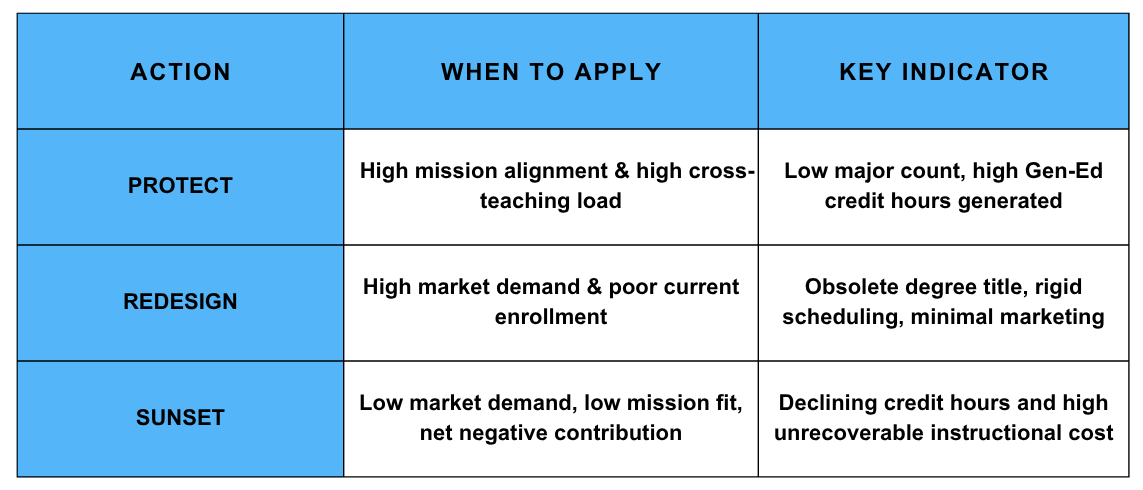
The goal isn’t to reduce academic decisions to dollars alone—it is to understand financial reality clearly enough to make better academic choices.
4. Data Should Inform Decisions, Not Replace Judgment
Academic portfolio strategy is not a mechanical spreadsheet exercise; it is an exercise in leadership.
Data can highlight employer needs, student interest, competitive intensity, enrollment trends, and unit economics. But data alone cannot define a college’s core mission, decide its identity, or replace faculty expertise.
The best portfolio decisions combine rigorous evidence with thoughtful academic judgment. On the purpose of data-informed evaluation, Bob Atkins notes:
“It will propose a process that brings together faculty and administrators and teaches them how to use the data to inform their judgment and make better decisions.”
Smarter reviews bring together academic leaders, faculty, finance teams, institutional research, and admissions. They ask not just what is growing or shrinking, but why.
5. Real Strategy Is Choice
Every institution operates with limited resources. Not every program can grow, not every legacy degree should continue as-is, and not every trendy idea deserves a launch.
However, reflexively cutting small programs is not a strategy. Real strategy is choice.
- Start with what aligns with market demand, mission, and capacity.
- Stop what clear evidence demonstrates is no longer viable.
- Grow what has real potential and market momentum.
- Fix what has solid core demand but suffers from poor structure or positioning.
- Partner on critical offerings that serve the community, even if you shouldn’t build them alone.
Shoring up institutional finances may require hard cuts at times. But cuts alone will never build a future. A genuine academic portfolio strategy helps colleges protect what truly matters, invest where they can succeed, and make deliberate choices rooted in evidence, transparency, and purpose.
Join the Conversation
How does your institution evaluate academic portfolio health? Are your decisions driven by course-level economics or strictly by major headcount? Share your thoughts at info@graydi.us