


Don’t Stop Now! The Decline in Program Announcements Threatens Future Enrollment

March 19, 2026

When you’re steering around potholes and ice patches, it’s not always easy to remember to keep your foot steadily on the gas so you don’t just stop.

Your next year’s enrollment numbers will depend, in part, on the attractiveness of your program offerings.  If your website was promoting Statistics when your peers were offering Data Science, that was a challenge.  Now, as prospective students are making their decisions, if you’re promoting Data Science while your peers are offering Artificial Intelligence, you’re at a disadvantage – because the students who want Artificial Intelligence will enroll elsewhere.

The 2024 Peak in Higher Ed Program Announcements

Gray DI has been tracking announcements of new academic programs for ten years.  2024 was a record year, with 1,029 new academic programs announced.  So, institutions were investing in their future.  At a minimum, by keeping their program portfolios fresh, they were keeping their gas tanks full so they didn’t inadvertently drift to a stop.

The Threatening 2025 Drop in Higher Ed Program Announcements

In contrast, 2025 saw a drop in new program announcements to COVID-era levels.  The many challenges of 2025 distracted institutions from building the new programs that will attract students in future years.
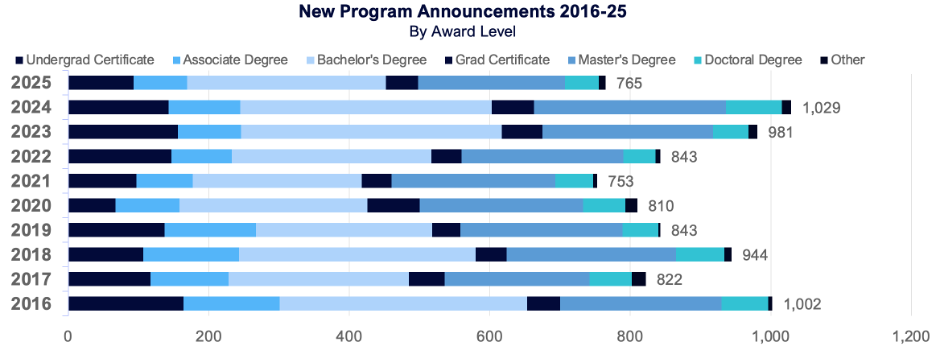
New Program Announcements 2016-25

Identifying High-Demand New Academic Programs in Your Market

Without a steady flow of new academic programs, institutions will struggle to maintain enrollments.  Therefore, colleges and universities need to identify the best new program ideas for their institution.

Often, institutions start with an idea and then gather the information to assess that idea.  The first problem with this approach is the lack of rigor in coming up with the best ideas in the first place.  The second problem is the lack of easily-accessible information for comparing competing program ideas to judge what the best options are for the institution.  Gray DI’s tools help at each stage of this process:

  • PES Markets and PES Predict Program Size can help by creating ranked lists of promising ideas, based on metrics like institution-specific enrollment forecasts for each program, high-growth programs at similar institutions, or programs with particularly strong employment opportunities. These systems include data for more than 1,500 programs for every geographic market in the United States.
  • PES Program Remix can generate institution-specific program ideas that can be developed primarily by remixing the institution’s currently-offered courses. These remixed programs should be faster and less costly to build than programs that require many new courses and capabilities.
  • PES Markets can help with assessing individual program ideas, considering student demand, competition, employment outcomes, and cost benchmarks – relative to other program ideas, not just in isolation.
  • PES Markets and PES Program Remix can help build program content and support, with additional data, easy-to-use reports, and guidance on reusing existing courses and creating new courses

If you’re not regularly recharging your academic program portfolio, you’re going to struggle to maintain forward momentum with enrollment.  Don’t wait until you’re rolling backwards down a steepening hill to restart your new-programs engine.


Steve Probst

SVP, Customer Success and Data Integrity

Steve works with colleges and universities to assess current and identify new academic programs, evaluate potential new geographic markets and campus locations, improve curricular efficiency, and address other strategic, enrollment, and financial challenges.

Quick Reference

While 2024 saw a record high of over 1,000 new program launches, 2025 has seen a significant drop to COVID-era levels. This decline is largely due to institutional distractions and market volatility. However, slowing down now creates a “pipeline gap” that could lead to declining enrollment in the coming years.

Prospective students seek programs that align with current market demands. For example, students looking for Artificial Intelligence will not settle for a standard Data Science degree. If your institution isn’t regularly refreshing its offerings, you risk losing students to competitors who are more aligned with modern career paths.

The most efficient method is “program remixing.” By using tools like PES Program Remix, institutions can identify how to package existing courses into new, high-demand credentials. This approach is faster and more cost-effective than building a curriculum from scratch because it leverages your current faculty and credits.

Success isn’t just about following national trends; it’s about local market fit. Using data-driven tools like PES Markets, institutions can rank potential programs based on institution-specific enrollment forecasts, regional competition, and employment outcomes for over 1,500 different programs.

Many institutions start with a faculty idea and then seek data to support it. A data-first strategy uses rigorous metrics to generate a list of the most promising opportunities first. This ensures that when a program is launched, there is already proven student demand and a clear path to employment.

It’s never too late to start, but the “steepening hill” of enrollment decline makes immediate action vital. By utilizing predictive tools like PES Predict, you can

Related Posts
Subscribe to Our Blog

Don’t miss our latest research and insights

Related Posts

Gray Insights

How Universities Can Make Better Academic Program Decisions: A Data-Informed Framework

Academic program decisions have never been more complex, yet many institutions still rely on incomplete signals or long-standing assumptions. Enrollment shifts, evolving workforce needs, and growing pressure to demonstrate outcomes are forcing leaders to rethink how programs are evaluated. Discover the key signals and strategic framework institutions are using to make smarter academic program decisions.

Read More
Gray Insights

Why Enrollment Declines Don’t Automatically Mean Program Cuts

When enrollment declines, the instinct to cut can feel like the safest financial move. But what if that decision actually creates a larger budget hole? Many smaller programs remain contribution positive, support high-volume general education, and hold untapped growth potential, while teach-out costs and ripple effects across student credit hours can quietly erase projected savings. Before reshaping your academic portfolio, it may be worth asking whether the real issue is the program, or the data behind the decision.

Read More
Gray Insights

An AI Infrastructure Boom Fueling Opportunities for Higher Education

AI is not just reshaping classrooms and careers, it is reshaping the physical world. A historic surge in data center construction is driving new energy demands, workforce shortages, and emerging academic opportunities that few institutions are fully prepared for. The question is not whether this infrastructure moment will impact higher education, but how quickly you will respond.

Read More