


Intro to Blog Series: By the Numbers
Welcome to this blog series from Gray Decision Intelligence on the numbers behind the realities, myths, and misinformation contributing to enrollment fears in higher education.
As we navigate the “Turbulent 20s” here in 2026, higher education leaders are facing a barrage of pessimistic forecasts. The enrollment challenges facing universities today go far deeper than simple population shifts. Higher education participation is a complex ecosystem influenced by a perfect storm of variables: economic volatility, a growing cultural skepticism toward degrees, a slowdown in hiring, fluctuating consumer purchasing power, and a rapidly evolving regulatory landscape.
In this series of blogs, we’re going to draw back the curtain and expose the realities behind the myths, misinformation, and real challenges that are spooking higher education institutions across the country.
The Elephant in the Room
We have long discussed the “demographic cliff” in abstract, academic terms, as a series of data points on a distant horizon. However, as we approach the 2026 academic year, those data points have transitioned from theoretical projections into a fundamental market reality. Is this the year higher education changes forever?
The “demographic cliff” refers to a significant, sudden drop in the number of college-age individuals. While population shifts are usually gradual, this drop has been predicted to be catastrophically sharp.
The root cause traces back exactly 18 years to the Great Recession of 2008. During that period of economic instability, birth rates in the U.S. plummeted. Since those missing babies would have been the high school graduates of 2025 and 2026, colleges are now facing a massive vacancy in their pipeline of “traditional college-age” students.
Crunching the Numbers
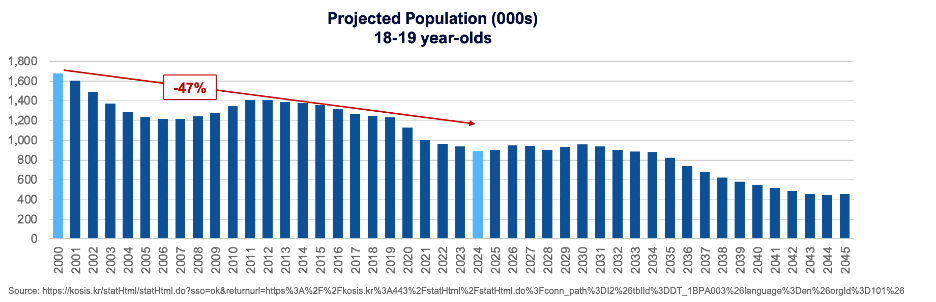
Our first look at a cliff shows that the population of 18-19 year-olds declined from 1.7 million in 2000 to 0.9 million in 2024, a 47% drop. That is the very definition of “precipitous.”
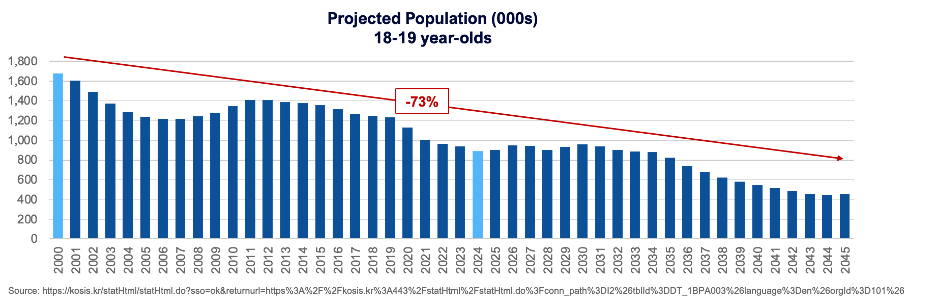
After a brief lull, the decline is expected to continue through 2045, when there would be only 0.46 million people in this age group, a 73% decline since 2000.
What Does This Mean for Universities?
The steep demographic decline has had a severe impact on colleges and universities. There were 40,000 empty seats in 2021, a number expected to rise to 100,000 empty seats in 2024/2025. Experts estimate that 10% of universities will soon be down to 50% of their target enrollment; this decline will be particularly acute at rural colleges since most students prefer to attend college in or near major cities. By late 2025, 19 colleges had closed; another 84 were deemed financially insecure and may close; in all, 24% of universities were closed or at risk.
The Silver Lining
Here’s the bad news: this demographic cliff is very real and very scary. The good news? The data we just showed you is for South Korea, not the United States. We do apologize for scaring you, but now that you know you were looking at another country’s terrifying reality, we can take a step back from that ledge and take a closer look at the complexities of our own situation here at home. In our next blog, we will take a deeper dive into the numbers that are behind the demographic cliff projections here in the U.S.