

In our last blog, we examined the data behind a widespread decline in enrollment rates. So what are some of the root causes behind this sharp downtick? And what is the current reality?
Higher education isn’t dying, but the blind faith era is officially over. The ivory tower is no longer revered – the public is demanding to see the blueprints. We’re moving away from “is college good?” toward a “show me the receipts” model of education where prestige matters less than tangible ROI. While a college degree remains an effective tool for economic mobility, public confidence in the system has been compromised.
Two Stories, Both Alike in Complexity: Public Confidence in Higher Ed and Public Perception of Value of a Degree
Recent polls show an increase in negativity that is impossible to ignore, yet a strange paradox is at play. Public perception of the degree is firmly rooted in pragmatism. The degree is a tool for survival and success. Public trust in higher education, however, is a sticky morass of opinions. It’s a “what you get” vs. “how you feel” situation. On the one hand, people are grumbling that a college degree is an overpriced piece of paper that either gets framed or buried forever in a box in your parents’ basement. On the other hand, current students are expressing a very different and largely positive view of the value of a college education. (Whether or not this involves confirmation bias is not for us to say.)
Polls and Perceptions: Knotty Wording of Questions
One challenge of writing about these issues is the wording of the questions. Words like “value”, “importance”, “worth”, “trust”, and “confidence” are often used interchangeably, which muddies the waters considerably.
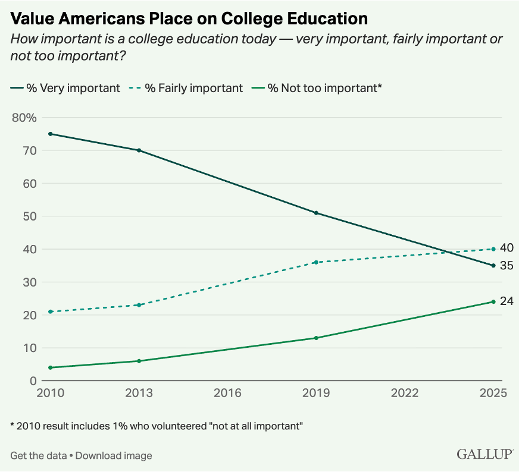
Let’s take a look at recent polls. Regarding the public perception of the “importance of higher education today”, Gallup reported in September 2025 that the percentage of Americans who believe a college education is “very important” hit a new low of 35 percent, down from 75 percent in 2010. Across all societal groups, half of the country (49 percent) believes a degree is actually less important today than it was 20 years ago.
When we look more closely at specific segments of this Gallup poll, we see that the decline in the perceived importance of a college education is particularly pronounced among 18-34-year-olds. In 2013, 74 percent of US adults aged 18-34 said college was “very important.” In 2025, that percentage shrank to only 35 percent. Younger adults are more likely to be negative than older adults. The decrease is also very sharp across both non-college graduates (36 percent) and college graduates (38 percent).
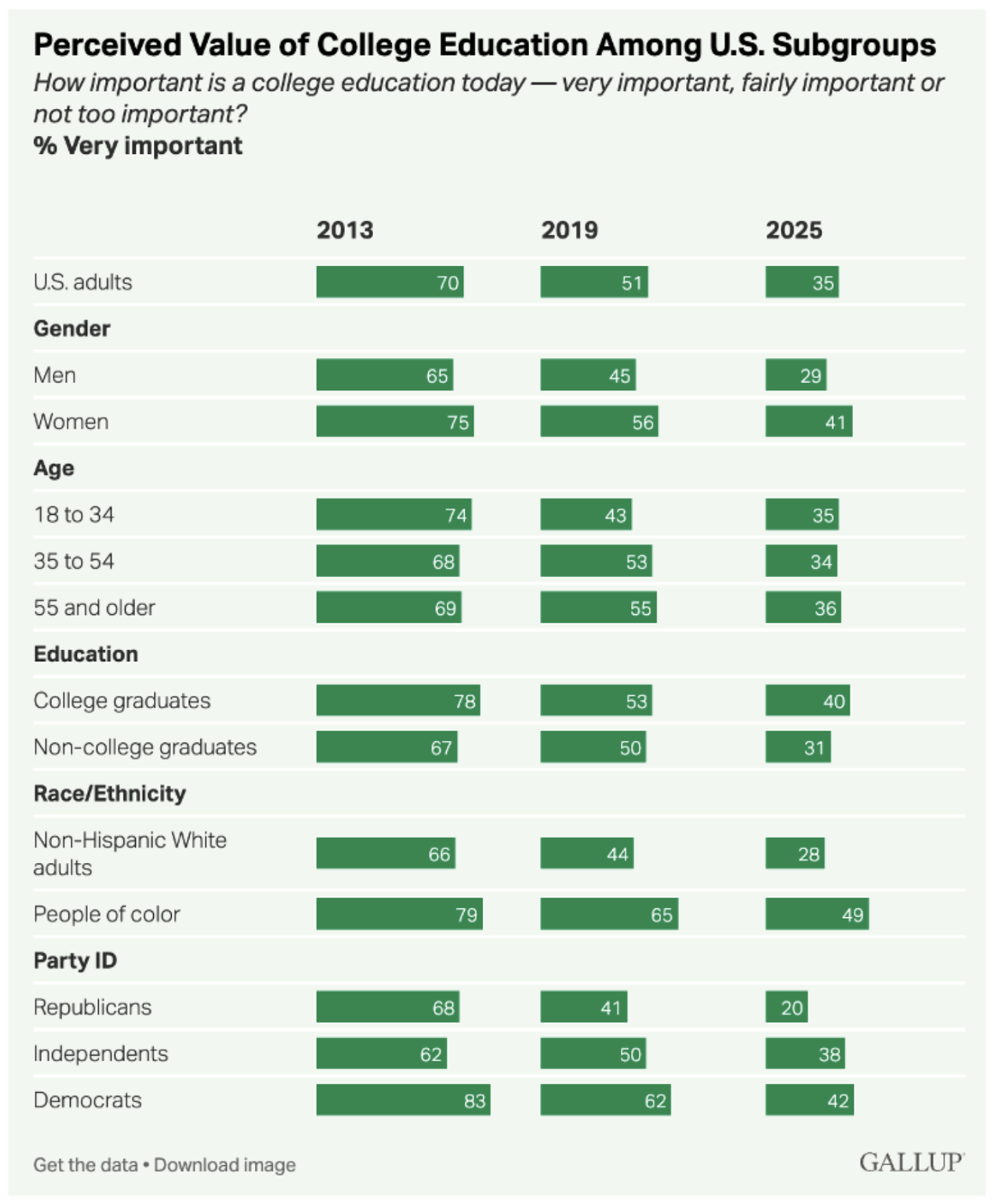
Interestingly, the decline in perceived value among non-Hispanic White adults (38 percent) is considerably steeper than the decline among people of color (30 percent).
Additionally, the “Some College, No Degree” (Some College) population is the physical embodiment of low-value higher education. As of early 2026, this group has grown to over 43 million Americans, representing roughly 1 in 6 adults. However, universities are actively trying to re-recruit students from the population of 43 million stopped-out adults to keep their institutions running. Examples of these initiatives include CUNY Reconnect and Degrees When Due.
Trust Fall
An October 2025 Pew Research Study shows public trust in the value of higher education hasn’t just dipped. It’s taken a plunge. This report shows that a staggering 70 percent of Americans believe the U.S. higher education system is “heading in the wrong direction.” For context, that’s up from 56 percent just five years ago, and it includes majorities across all major demographic groups. There is some variation across the groups polled; for instance, 76 percent of adults with a four-year college degree hold this view, vs. 69 percent of those without a college degree. The poll also shows that only 28 percent of adults with at least a bachelor’s degree say it’s extremely or very likely that someone without a college degree is likely to score a well-paying job; comparatively, 37 percent of the Some College population and 36 percent of those with a high school diploma or less say it is extremely likely or very likely.
A November 2025 NBC poll suggests that nearly two-thirds of registered voters say college is not worth the cost. Three recurring themes drive the negativity that the majority of Americans are expressing: cost and debt, political leanings and/or campus politicization, and the perceived lack of proof on the ROI of a degree.
Not All Doom and Gloom
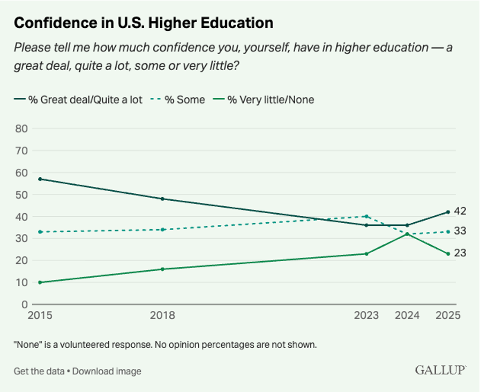
There was a slight rebound in the public’s confidence in higher education in the middle of last year: according to a July 2025 Gallup poll on public trust in higher education, a decade-long erosion of trust in American higher education may have finally hit a turning point. In 2015, 57 percent of Americans had a “great deal/quite a lot” of confidence in higher education; that number plummeted to 36 percent by 2023 and 2024. Then in 2025, confidence ticked up to 42 percent. Simultaneously, the segment of Americans expressing very little to no confidence has shrunk from 32 percent to 23 percent, a decline of nearly 10 points in a single year. This modest rebound is the first of its kind in Gallup’s tracking history. Though it’s a clear win for the industry, it’s also a reminder of the ground still to be gained: the system has yet to reclaim the broad 57 percent majority support it enjoyed back in 2015.
Bright Futures: Current College Students Are More Optimistic
And yet, a recent report from Gallup and the Lumina Foundation titled “The College Reality Check” examines a crucial sticking point in America’s expression of this lack of confidence: there is a great divide between what today’s students are actually experiencing vs. what America thinks. While the general public expresses significant skepticism, the report finds that those currently within the system report high levels of satisfaction regarding career preparation, academic freedom, and overall value. The report reveals a complex relationship between the perceived value of a degree and its price. Despite believing it is “worth it,” 57 percent of students say four-year universities do not charge fair prices.
In the next blog in our series, we will discuss the many factors contributing to the ongoing debate over whether college is “worth it.”
Spoiler alert: it is!
Takeaways:
- Public confidence in higher education is improving at a modest rate.
- While a college degree remains extremely valuable, public perception of higher education’s value is very low and keeps sinking.