

Scouting the news, AI-generated or otherwise, can give those of us in higher education whiplash.
Enrollment is up. Google searches for academic programs are down. Job postings are rising. International interest is dropping. AI is everywhere, but actual campus adoption is uneven. Computer science is supposedly “over,” except the job market still has plenty of demand.
So, what should colleges do with all of that?
The answer is not to chase every headline. It is to check in on the data each month at least monthly and build a faster, smarter, more data-informed process to evaluate our programs.
Because the market is moving, students are moving. Employers are moving. And the institutions that wait too long to catch up may find themselves making yesterday’s decisions tomorrow. And to carry it further, that is today’s reality. Welcome to higher ed strategy in 2026: the signals are not simple, but they are actionable.
Let’s take a look at the trends that were featured in our April 2026 Higher Education Trends webinar.
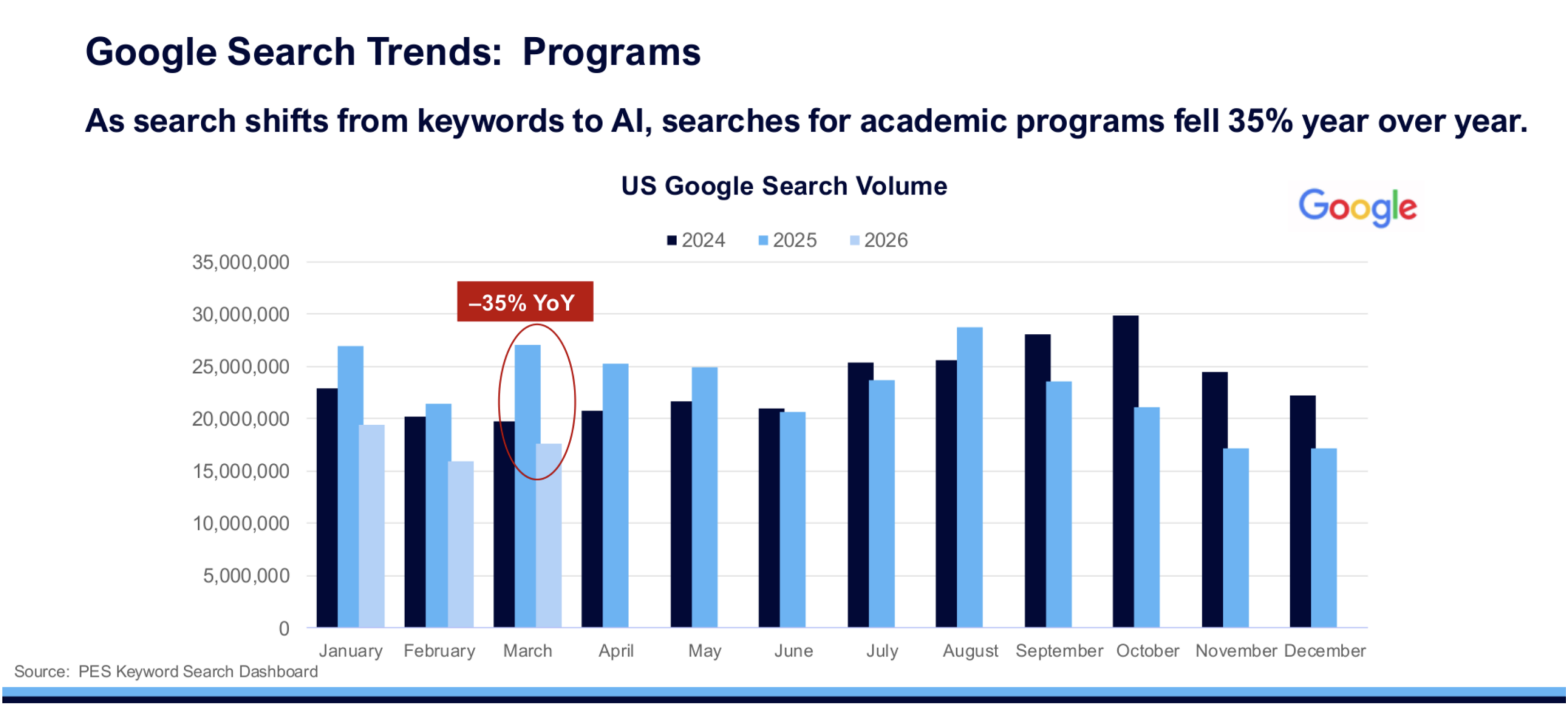
In March, Academic program searches fell 35 percent year over year, a sign that student discovery may be shifting from traditional search toward AI-assisted exploration. Source: Gray DI’s PES Keyword Search Dashboard.
College Enrollment is Growing for Specific Programs
Here is the good news: the higher education market is not collapsing.
In Fall 2025, enrollment at the certificate and associate levels rose three percent year over year. Bachelor’s enrollment grew by two percent. Master’s and doctoral enrollment rose by one percent. That is not a boom. But it is a clear sign that higher ed demand is still very much alive.
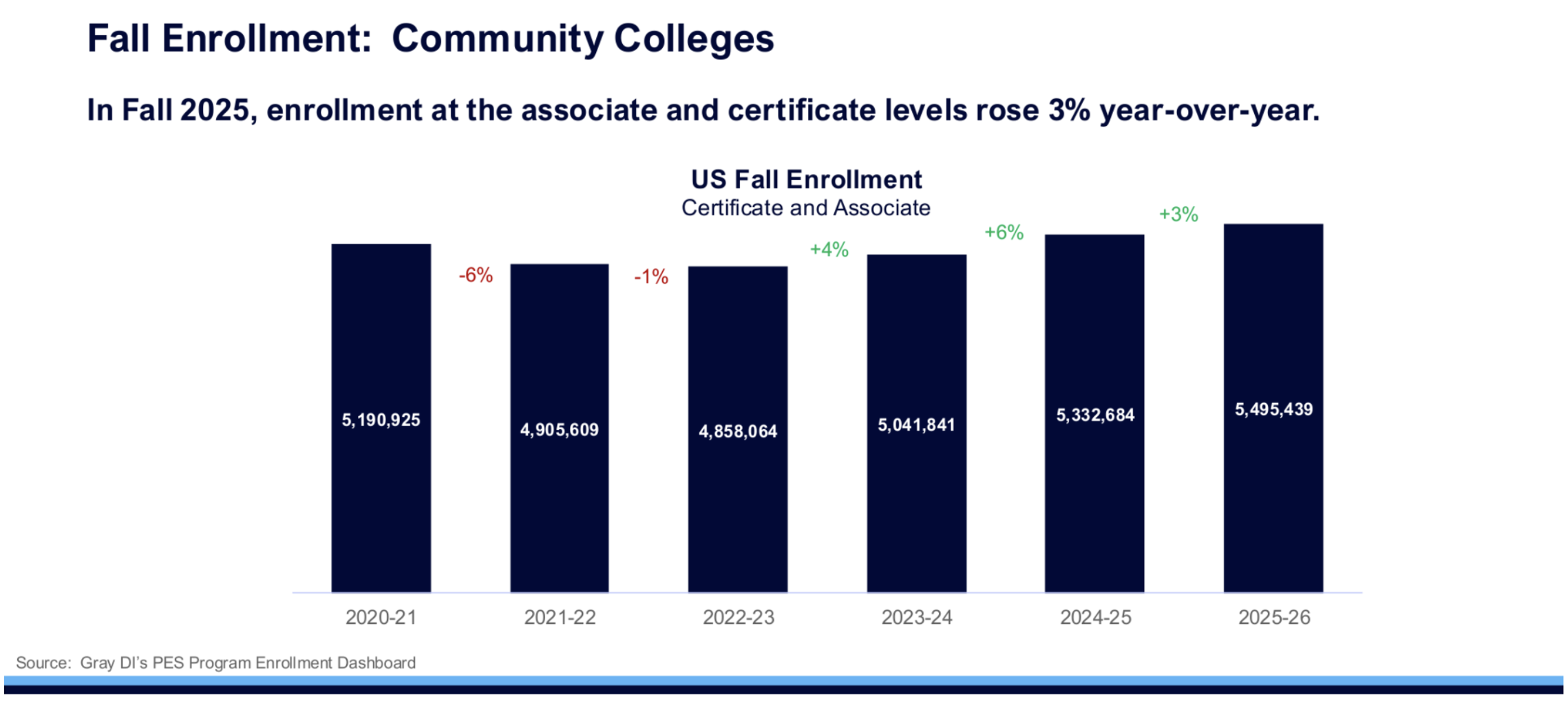
Community college enrollment is moving in the right direction, with certificate and associate enrollment up three percent year over year in Fall 2025. Source: Gray DI’s PES Program Enrollment Dashboard.
The more interesting question is where the growth is happening.
At the certificate level, Medical/Health Management grew 37 percent annually from Fall 2020 to Fall 2025. Cybersecurity grew 18 percent annually both at the associate level and at the bachelor’s level. Data Analytics and/or Data Science grew 35 percent annually at the master’s and doctoral levels.
That is not a random collection of programs. It points to a larger pattern: health, technology, applied business, and career-connected programs continue to show strong momentum.
Not every college needs to launch the same program. But every college should know which programs are gaining traction, which ones fit its mission, and which ones can actually be sustained.
Employer demand is not waiting politely
While student signals are shifting, employer demand is shifting as well.
In March 2026, US job postings rose 15 percent year over year. That is a big signal for colleges and universities trying to connect academic programs to opportunity.
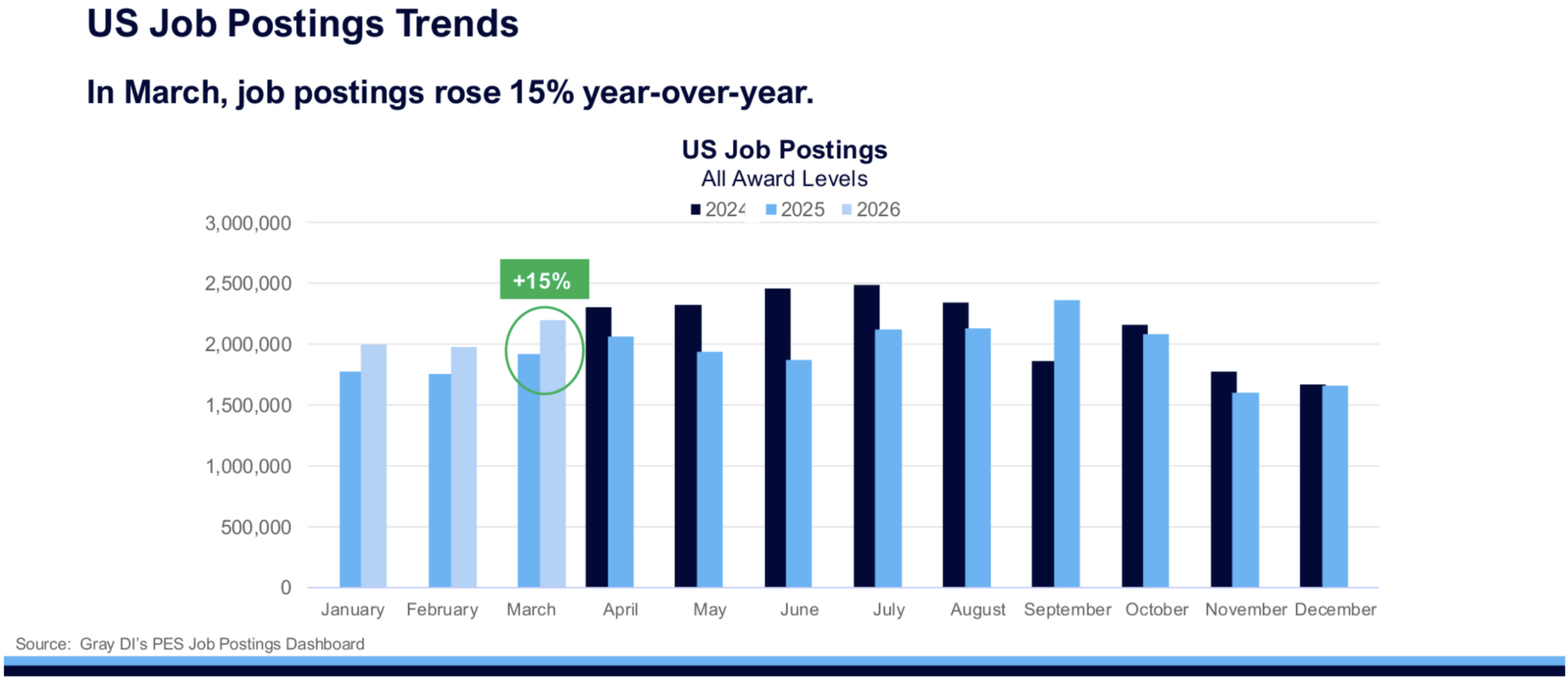
Employer demand is rising: U.S. job postings increased 15 percent year over year in March 2026. Source: Gray DI’s PES Job Postings Dashboard.
The fastest-growing occupations included industrial engineers, heavy and tractor-trailer truck drivers, physical therapists, software development and QA analysts, marketing managers, financial managers, real estate sales agents, general and operations managers, project management specialists, and construction managers.
That mix matters.
It is not just “tech is growing.” It is Operations. Healthcare. Management. Logistics. Software. Construction. Business.
In other words, the labor market is not sending a single clear signal. It is sending many. Institutions need a way to read those signals in total.
The Skills Market is Moving Fast
The skills data is where things get interesting.
In March 2026, demand for Amazon Web Services skills grew 857 percent year over year. Cloud computing grew 394 percent. Artificial intelligence grew 227 percent. Data centers grew 160 percent.
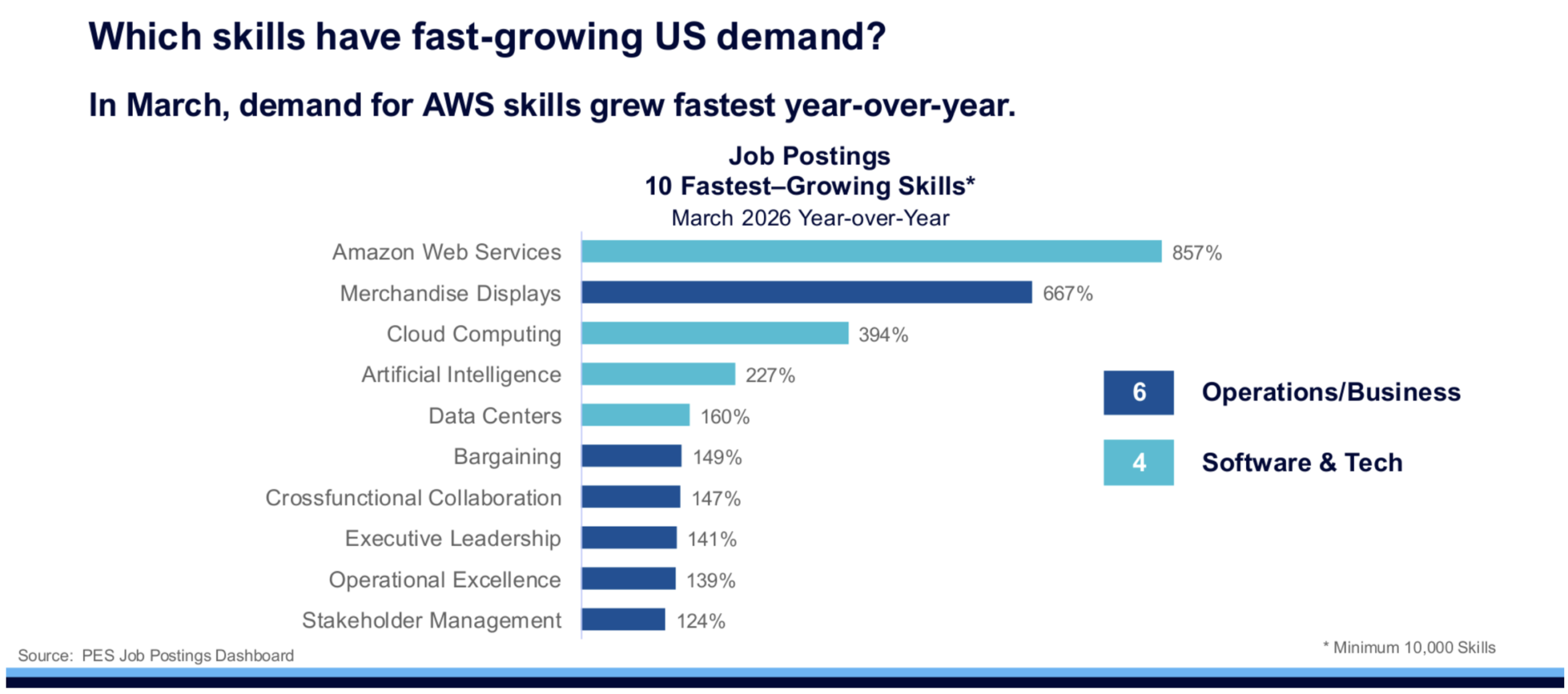
The fastest-growing skills point to where program strategy may need to move next: cloud, AI, data centers, and cross-functional leadership. Source: Gray DI’s PES Job Postings Dashboard.
This is why program strategy cannot be limited to degree titles.
A computer science program may still be strong, but does it include cloud infrastructure? A business program may be popular, but does it teach data-informed decision-making? A healthcare program may have demand, but does it reflect where care delivery, technology, and operations are headed?
The opportunity is not always a brand-new program. Sometimes it is a new concentration, certificate, course sequence, embedded skill, or clearer pathway from classroom to career.
That is where institutions can move faster without becoming reckless.
Computer Science is Getting More Complicated
The computer science story is more nuanced than the headlines suggest.
Yes, students are hearing the noise about AI and the tech job market. Yes, enrollment signals are softening in some places. Yes, leaders should be paying attention.
But the idea that computer science has fallen off a cliff is too simplistic.
In Gray DI’s analysis, Computer Science still scored in the 98th percentile for student demand and the 99th percentile for employment opportunities. But there are warning signs. New student enrollment fell 12 percent, international page views dropped 19 percent year over year in Q1, and median program size declined.
That is exactly the kind of mixed signal leaders need to see clearly.
The strategic question is not, “Should we panic about computer science?”
It is, “How should computer science evolve?”
Programs may need stronger AI integration, cloud skills, software testing, cybersecurity, applied analytics, and clearer career pathways. Institutions may also need better messaging for students who are interested in tech but worried about whether the field still has a future.
Spoiler: it does. But the old version of the story may not be enough.
The volatility we see isn’t a sign of higher education’s decline, but of its rapid transformation. When AWS demand jumps 857 percent and Computer Science enrollment softens despite peak job prospects, the old “set it and forget it” model of academic planning becomes a liability. Success in this climate requires more than just intuition: it demands a shift from reactive guessing to proactive, monthly data cycles. By synthesizing student interests, employer needs, and emerging skill clusters, institutions can build programs that are resilient and agile enough to take advantage of growth opportunities.
Want the data behind the trends? Join Gray DI’s monthly Demand Trends webinar for a faster read on student demand, employment shifts, and the program opportunities higher ed leaders should be watching next.
Charts are from Gray DI’s April 2026 Monthly Higher Ed Demand Trends deck.