


IPEDS 2025 Completions Data Is Here: Big Growth Trends & Platform Updates

August 6, 2026

The IPEDS 2025 completions dataset has officially landed, and the top-line numbers bring some of the most notable higher-ed news we’ve seen in years! Beyond the macro trends, our team has been updating data mappings, logic, and search metrics to ensure your analysis in Gray DI PES Markets remains as accurate and actionable as possible.

Here is a breakdown of the latest data to keep your insights ahead of the curve.

The Big Picture: A Historic 4.5 Percent Jump in Completions

Total completions surged 4.5 percent year-over-year to 5,802,727—marking the largest annual increase in postsecondary completions since 2011.

While growth was positive across every single award level, short-term and non-degree credentials led the charge:
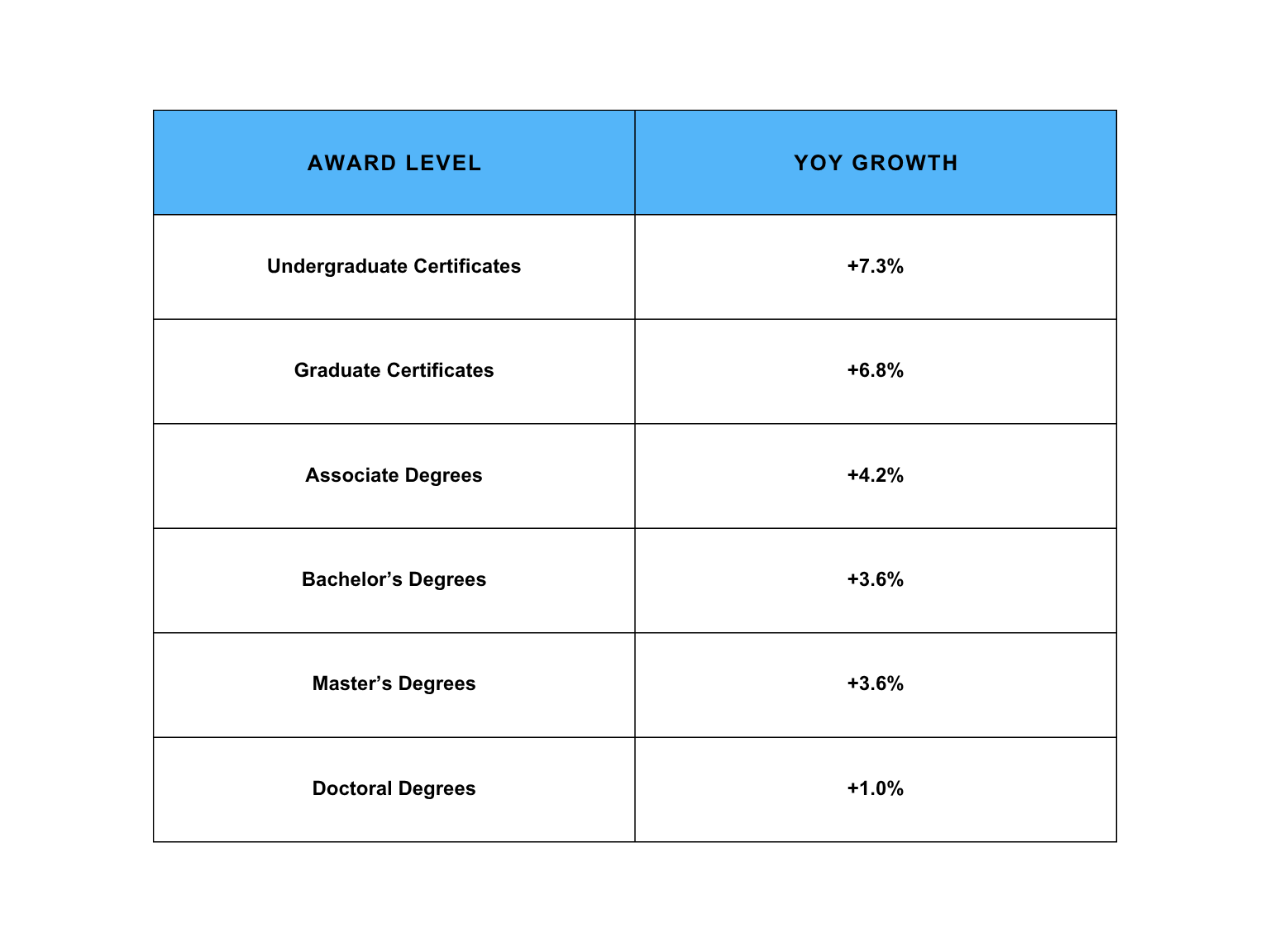
Source: Gray DI

Context Note: The sharp rise in undergraduate certificates partly reflects evolving institutional reporting practices, specifically, the capture of embedded certificates and minors awarded within larger degree programs.

Refining the Data: CIP & UNITID Logic Updates

An annual update always brings new code combinations, giving us the opportunity to fine-tune our mapping logic for maximum precision. For example: 

  • Targeted Logic Refinement: We resolved a common overlap between two closely titled health science CIPs:
    • CIP 51.1004 (Clinical/Medical Laboratory Technician) → Standardized to Associate degrees
    • CIP 51.1005 (Clinical Lab Science/Medical Tech) → Standardized to Bachelor’s degrees or higher

Forcing this distinction improves matching accuracy across competitor supply, student demand, and regional labor market outcomes.

Feature Spotlight: Award-Level Google Search Data

Thanks to some heavy lifting by our team, our Google search demand dataset has been completely revised to display by award level.

  • Why this matters: Previously, high search interest for a general topic could artificially inflate student demand metrics for an award level where the program didn’t make practical sense (e.g., searches for a professional degree showing demand at the associate certificate level).
  • What’s next: This update eliminates those mismatches. The app update will publish shortly, and these level-specific search metrics will be fully integrated into our next PES Markets release!

We’ll keep digging into these 2025 numbers and sharing more findings as we uncover them. Stay tuned for further takeaways, and reach out if you would like us to cover a particular program.  

Email us at info@graydi.us

Schedule time to talk with us about access to more insights.

Mary Ann Romans

Associate Vice President, Marketing

Mary Ann creates, defines, and executes marketing strategy at Gray Decision Intelligence.

About Gray DI

Gray DI provides data, software, and facilitated processes that power higher-education decisions. Our data and AI insights inform program choices, optimize finances, and fuel growth in a challenging market—one data-informed decision at a time.

Related Posts
Subscribe to Our Blog

Join over 1,500 higher ed leaders receiving these insights

Quick Reference

The IPEDS 2025 completions data shows that total postsecondary completions increased 4.5 percent year over year to 5,802,727 awards. This was the largest annual increase in completions since 2011, with growth occurring across every award level.

Undergraduate certificates recorded the fastest growth at 7.3 percent, followed by graduate certificates at 6.8 percent. Associate degrees increased 4.2 percent, while bachelor’s and master’s degrees each grew 3.6 percent. Doctoral degrees increased 1 percent.

The increase may reflect both growing demand for short-term credentials and changes in how institutions report awards. Some institutions are now more consistently reporting embedded certificates and minors that students earn while completing a larger degree program.

Refining CIP code mappings helps ensure that programs are compared with the correct award levels, competitors, and occupations. For example, separating clinical laboratory technician programs from clinical laboratory science programs prevents associate-level and bachelor ’s-level programs from being grouped incorrectly.

Separating Google search demand by award level provides a more realistic measure of student interest. It prevents strong search activity for one type of credential, such as a professional or graduate degree, from artificially increasing demand estimates for unrelated certificate or associate-level programs.

The new completions data, updated CIP mappings, and award-level search metrics will improve the accuracy of competitor supply, student demand, and regional market analysis in PES Markets. These updates will help institutions evaluate program opportunities using more precise and relevant data.

Related Posts

Gray Data

Is It Just Me, or is AI Taking Over the Course Catalog?

AI is reshaping course catalogs at a rapid pace, with program announcements up 40% in just six months. New offerings span certificates, degrees, and flexible formats across every level. Explore how institutions are evolving to meet shifting student and workforce demand

Read More
Gray Data

Undergraduate Growth vs. Graduate Collapse

International enrollment is changing in ways that few expected, with undergraduate interest staying strong while graduate demand slips faster than anticipated. Early signals show sharp drops in global engagement and surprising shifts in program preferences. Explore what is driving this turn and how it may shape institutional priorities in the year ahead.

Read More