


In our last blog, we waded into the topic of the public’s perception of higher education and found that, while polls show that American confidence in the value of a degree is still quite low, it is rebounding… a little bit. In this blog in our series, we tackle the mystery of “Is college worth it?”
The refrain that “college isn’t worth it” has become a regular feature of American discourse. It’s haunting academia, prospective and current students, recent graduates, parents, and the workforce…you name it. Higher education leadership currently faces a significant gap between perception and reality.
So, is college worth it?
As Sir Arthur Conan Doyle put it, “There is nothing more deceptive than an obvious fact.”
The Case of the ROI Misgivings
Is the panic over the ROI on a college degree the primary suspect in our investigation?
A report from the Georgetown University Center on Education and the Workforce (CEW), titled “A First Try at ROI: Ranking 4,500 Colleges,” attempts to provide the most comprehensive answer to date. By analyzing data from the U.S. Department of Education’s College Scorecard, researchers calculated the Net Present Value (NPV), which is essentially the profit of a degree, net of expenses and wages foregone during college, for thousands of institutions over a 40-year horizon. The report suggests an interesting split in NPV depending on when it is measured. Consider the 10-year sprint vs. the 40-year marathon. The former reflects the short-term return: community colleges and certificate programs offer the highest ROI after 10 years. Because these programs are shorter and cheaper, students enter the workforce faster with less debt, leading to a quicker break-even point. The latter considers the long term: 40 years after enrollment, the median NPV for all colleges rises to roughly $723,000.
In 2015, the Social Security Administration reported that men with bachelor’s degrees earn approximately $900,000 more in median lifetime earnings than high school graduates; women with bachelor’s degrees earn approximately $630,000 more. The College Board’s Education Pays 2026 report reveals that a bachelor’s degree provides considerable financial ROI. As of 2024, bachelor’s degree holders earn a median of $31,200 more annually than high school graduates. This ROI is influenced by factors such as field of study and total debt accrued, and the typical four-year graduate reaches a break-even point by age 34, at which point their cumulative earnings have fully compensated for both the cost of tuition and the four years of lost wages.
But wait! Other suspects are lurking in the shadows.
The Case of the So-Called “Useless Major”
So if the value is there, why the skepticism? A likely suspect: the NCES CIP-SOC crosswalk, which aligns academic programs (CIPs) with occupations (SOCs). It is commonly used by universities, labor data vendors, and pundits to frame career opportunities and outcomes for college graduates. However, instead of tracking where students actually end up, the NCES crosswalk relies heavily on narrow, outdated assumptions, which by their own admission, are “not based on actual empirical data.”¹
Below are a few examples of the errors embedded in commonly used labor data that relies on the NCES crosswalk:
¹ https://nces.ed.gov/ipeds/cipcode/post3.aspx?y=56
Philosophy majors: The NCES crosswalk indicates that Philosophy majors enter only a single occupation: Postsecondary Philosophy and Religion Teachers, a job that requires a doctoral degree. Although this occupation has solid median wages ($78,050 in 2024), using this crosswalk provides an extremely limited view of potential career outcomes for students in this major.
The reality, found in data from 30 million alumni records, is that graduates with a bachelor’s degree in Philosophy go into over 750 different occupations, including various types of managers (e.g., general and operations managers, sales managers, marketing managers), lawyers, financial analysts, and software developers (utilizing their training in formal logic). Median post-entry wages for Philosophy majors (across all of these occupations) are $95,597.
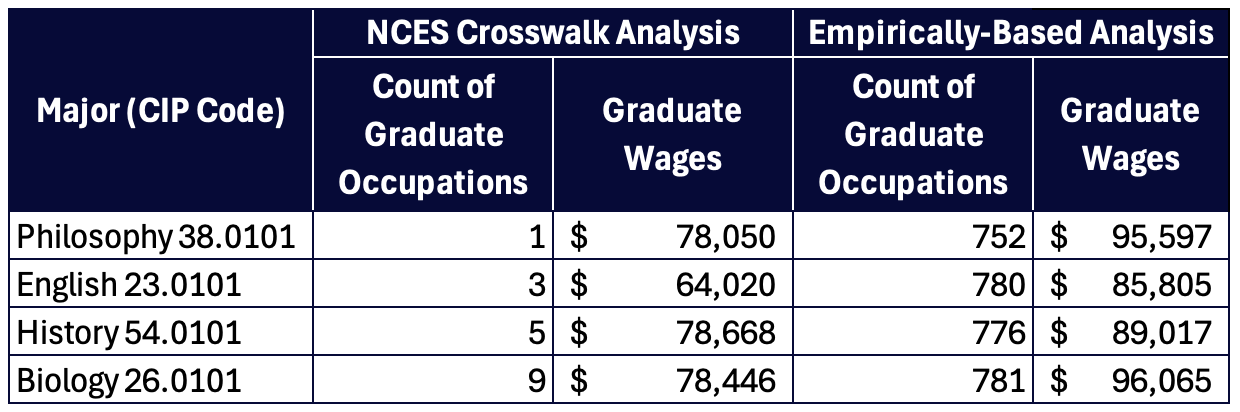
Similarly, English majors enter 780 different occupations over the course of their careers, not just the three indicated in the NCES crosswalk. Some common occupations include Advertising and Promotions Managers, Project Management/Business Operations Specialists, and Writers and Authors. Median post-entry wages for English majors across all occupations are $85,805.
These aren’t value problems; they’re measurement problems. A look at jobs for History majors shows a similar pattern to the realities for English majors. The number of occupations: 776. The top occupations: Lawyers, Project Management/Business Operations Specialists, Sales Managers, and so on.
The number of jobs for graduates with a BA in Biology sits at 781, and the top occupations include Industrial Engineering Technicians, Clinical Laboratory Techs, Physician Assistants, and Natural Sciences Managers.
Long story short: in Gray DI’s review of 634 total academic programs, we found that for 80% of programs, fewer than 20% of graduates actually go into the fields for which NCES states they are “directly prepared.” As a result, there appear to be many fewer jobs available to graduates and much lower potential wages: NCES wasn’t kidding; their crosswalk really is “not based on actual, empirical data.”
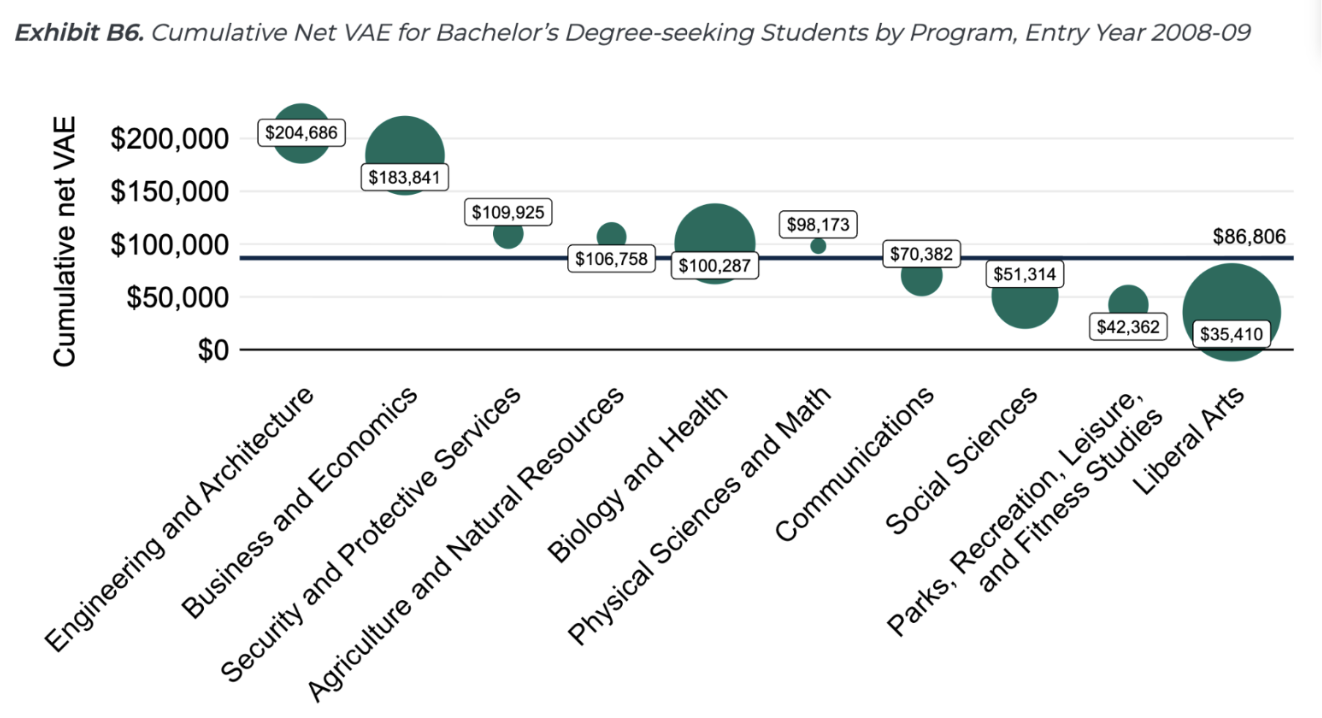
Additionally, a recent Texas study from the Postsecondary Commission (PSC) shows that “All ten (100%) of programmatic cohorts of bachelor’s degree-seeking students who enrolled in 2008-09 experienced positive cumulative net VAE (Value-Added Earnings).”
Verrrrry interesting. But who is skulking around over there??
The Case of the Debt Narrative
We are being told a tale of a generation crushed by debt, but the math suggests a different story. The average undergraduate loan is $25,670. The average federal student loan debt per student is $39,075. As of early 2026, the average auto loan debt for new vehicles is roughly $43,582, and for used vehicles, it is roughly $27,528. It costs more to buy a used Ford than it does to pay for a four-year degree. We accept $1.66 trillion in national car debt without a second thought, yet treat $1.77 trillion in student debt as a national catastrophe, even though a car depreciates the moment it leaves the lot, and a degree yields a $1 million career dividend. While it may be overblown, the debt burden is real – and substantially exceeds the norms for developed countries, especially in Western Europe.
What we aren’t talking about enough is this:
The single most significant risk factor in higher education is failing to graduate. An individual who does not complete college still carries debt and reaps none of the rewards a degree can bring, e.g., career leverage.
Those who take out student loans, enter college, and then do not complete represent the worst possible financial outcome for the student, the university, and taxpayers (who fund student loans). Student loan borrowers who drop out of college report much lower financial well-being than those who never enrolled; they are also far more likely to default on their loans. Additionally, the population of non-completers is growing; in a recent five-year period, more than 7 million adults dropped out. As of 2025, approximately 43.1 million Americans were enrolled in higher education but left before earning a degree or certificate.
This has a major impact on the economy as a whole. Billions in lost tax revenue. A shrunken GDP. The taxpayer burden of student loan defaults. The list goes on. For higher ed, the growing population of some-college-no-degree students is a real issue: it increases costs, reduces potential revenue, and damages the brand of the institution and higher education as a whole.
Mystery Solved! Now, How to Proceed?
Higher education leadership currently faces a significant gap between perception and reality. The national conversation remains preoccupied with an overstated debt crisis and the “useless degree” trope. Better data can help address these issues – and has been used to good effect in several statehouses. We believe that well-structured AI applications can improve student learning, reduce dropouts, and improve job placement. All of this will take years.
In the meantime, let’s remember that College provides a social and intellectual infrastructure that is hard to replicate with short-term programs and YouTube tutorials. As AI takes over routine technical tasks, other skills may become more important, including critical thinking, ethical reasoning, cross-disciplinary communication, and cross-social group communication. College is one of the few environments designed to sharpen these durable skills and develop the intellectual horsepower needed to succeed in an AI-driven world.
“…a case for higher education is a case for humanity.¹”