


Why are fewer “traditional college-age” students opting into higher education?
In our last blog, we discussed the realities of the numbers behind demographic cliff projections in the US, and why Grawe’s ominous “cliff” might actually be more like a bunny slope than a double black diamond. However, this doesn’t mean colleges and universities are off the trail. Declining enrollment is a real threat that needs to be addressed; understanding why (and how many) 18-year-olds are not choosing college is an essential piece of the puzzle.
Enrollment was Declining Before the “Cliff”
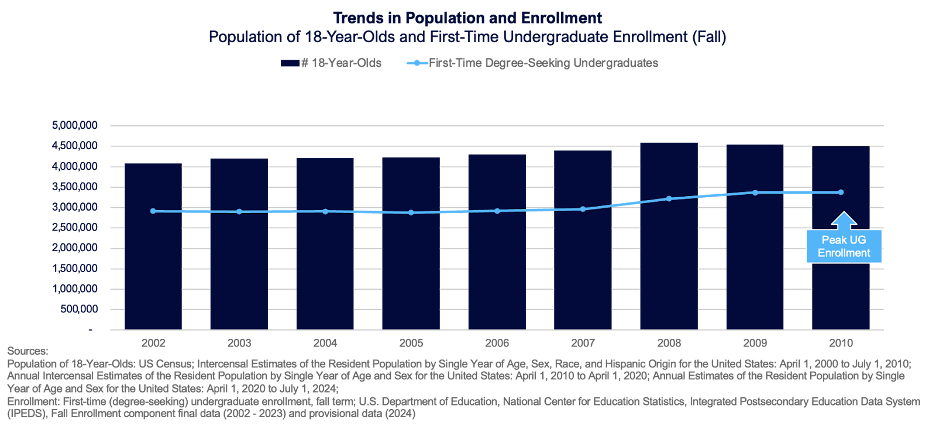
While the “cliff” is about a lack of available students, the pre-cliff decline was driven by a shift in behavior among the students who were already here. If demographics alone drove enrollment, we would expect college enrollment to rise in lockstep with the population of 18-year-olds. Yet while this held true through 2010, in later years, even as the number of college-age young adults held fairly constant, college enrollment saw periods of decline.
According to the US Census, the number of 18-year-olds rose from 4.1 million in 2002 to 4.5 million in 2010. Indeed, during this time, first-time undergraduate enrollment also grew, peaking in 2010 at 3.37 million students.
However, from 2010 to 2018, as the number of 18-year-olds remained fairly constant (rising by 0.5 percent by 2018), enrollment declined by 11 percent.
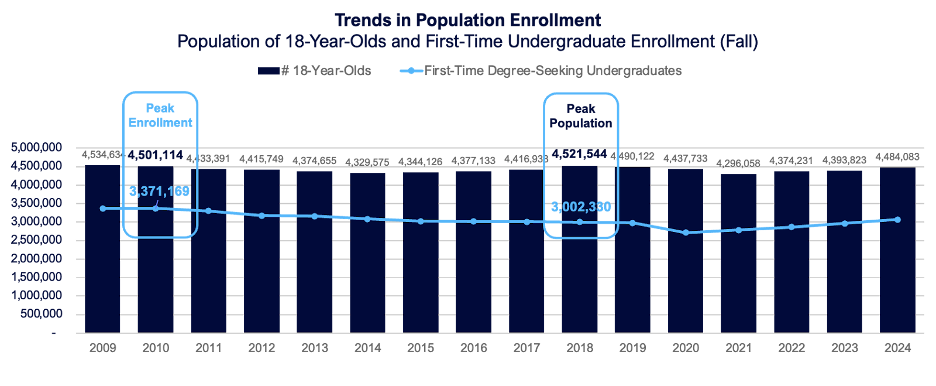
Fortunately, enrollment began to tick up again in 2021, even as the population of 18-year-olds declined very slowly. From 2018 to 2024, the number of 18-year-olds fell 0.8 percent, while first-time undergraduate enrollment rose 2.1 percent.
Propensity to Enroll
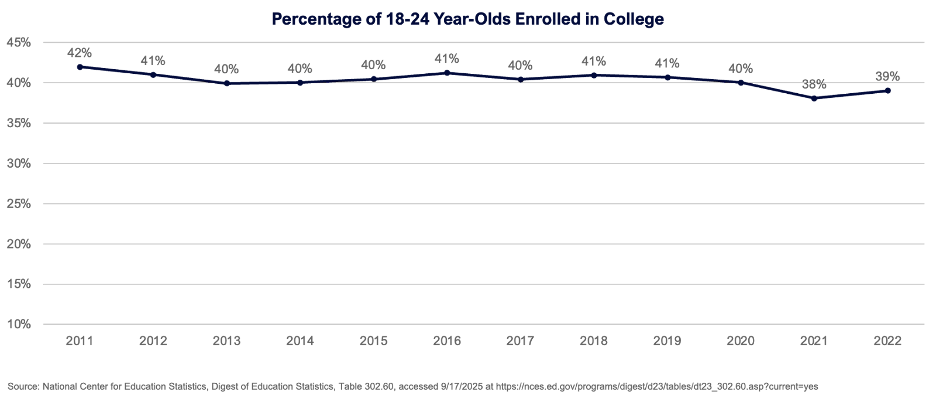
Notwithstanding the actual number of 18-year-olds, the percentage of young adults choosing to attend college is dropping precipitously. Recent figures show that between 2011 and 2022, the total college-going rate among 18- to 24-year-olds dropped from 42% to 39%. While a three-percentage-point decline might seem minimal, it represents a loss of roughly 900,000 potential students in just over a decade.
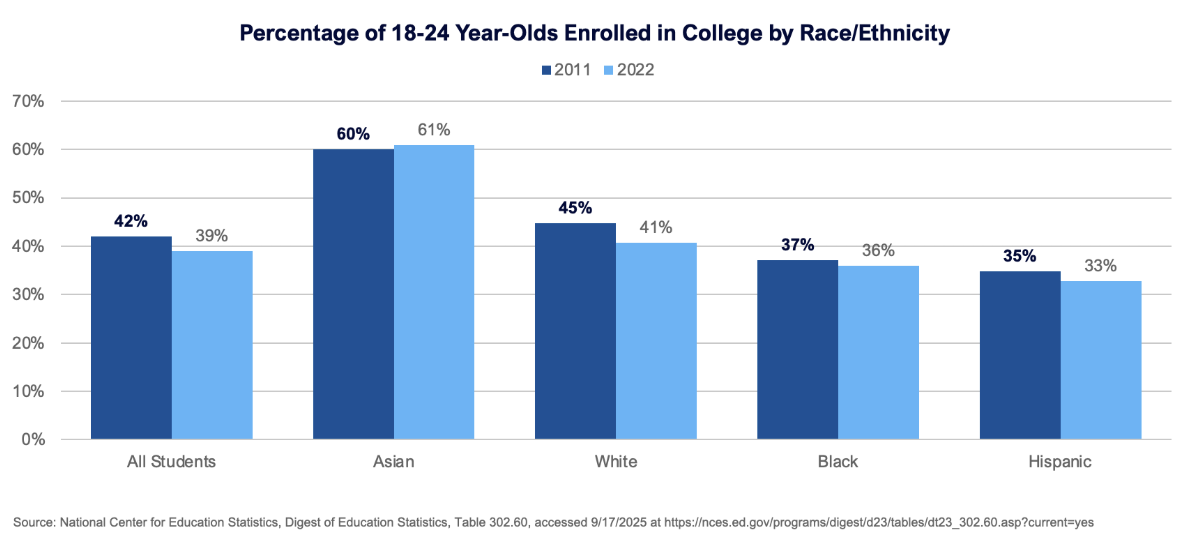
While enrollment rates for Asian students increased by 1%, those for all other ethnicities declined by 1% to 4%. Overall enrollment rates among White, Black, and Hispanic students converged slightly. The gap between White and Black student enrollment declined 3%. The gap between White and Hispanic students dropped from 10% to 8%. Rising enrollment among Black and Hispanic students did not drive the convergence in college-going rates; instead, a decline by 4% in White enrollment was the leading cause.
Enrollment rates by gender diverged sharply. While enrollment rates by ethnicity were slowly converging, the rates for male and female students were diverging rapidly. In 2011, there was already a notable gap, with 45% of females and 39% of males enrolled. By 2022, that gap had become a ten-percentage-point chasm.
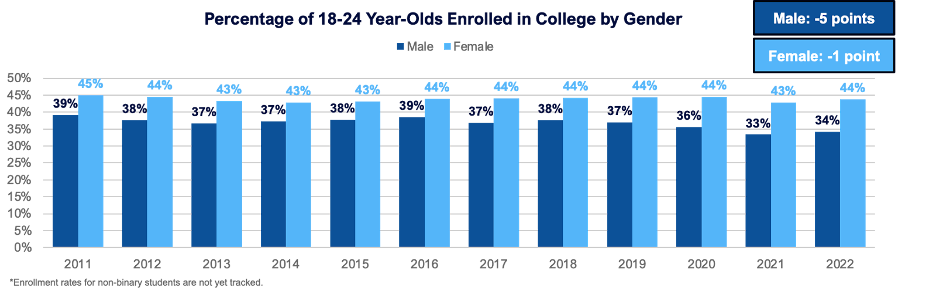
Between 2011 and 2022, the probability of an 18- to 24-year-old male enrolling in college dropped from 39% to 34% (while female enrollment remained fairly steady, declining one percentage point). If male enrollment had remained steady, higher education would have ~750,000 more male students today. This disengagement costs the higher education sector over $9 billion in lost tuition and fees annually.¹
¹Calculations based on estimated enrollment of 18-24 year-olds using enrollment rates from NCES, IPEDS fall enrollment data, and US Census population estimates. Lost tuition and fees estimated using average tuition and required fees (2024-25) for public and private institutions, and enrollment share by institution type.
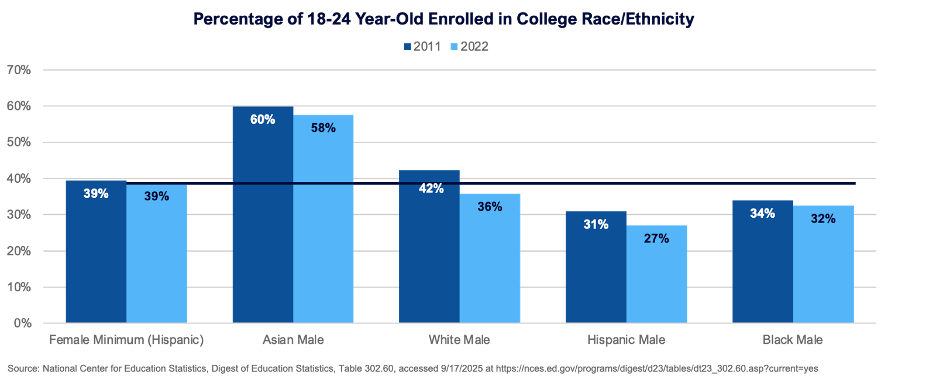
The largest decline in enrollment rates, from 42.4% to 35.7%, was for White males. By 2022, a White male was less likely to be in college than a female, regardless of race. Among Hispanics, female enrollment declined by 0.7% (from 39.4% to 38.7%), while Hispanic male enrollment declined by 3.9% (from 31.0% to 27.1%).
The story of “missing” college students isn’t about capacity or capability; it is overwhelmingly a crisis of participation among young men. While women of color (particularly Hispanic females) are successfully pushing enrollment rates upward, many men across all demographics are opting to join the workforce – or unemployment.
To offset the cliff, we will need to restore or increase enrollment rates for students of all genders and ethnicities, both domestically and internationally, on-campus and online.
In our next blog, we will explore a societal shift that is contributing to declining enrollment.
Takeaways:
- Fewer young adults are enrolling in college.
- Enrollment’s “biggest losers” are males.
Chart notes: The base years for the previous three charts were chosen to provide the longest time series using data from different sources (e.g., NCES, IPEDS, and the US Census). Choosing different base years, especially for enrollment rates, produces slight changes in the analysis; the overall decline in enrollment rates across all ethnicities is fairly constant, but the changes in individual ethnicities differ. For example, using a base year of 2010, enrollment rates for Hispanic students increased by 1% from 2010 to 2022, while enrollment rates for Asian students declined by 3%. Male enrollment rates also showed a slightly steeper decline when using a base year of 2011 (-5 percentage points) rather than 2010 (-4 percentage points).